Categories
Catholic Church Italy Papacy Travel

Corpus Christi

In the Catholic Church, today is the Feast of Corpus Christi, a day we commemorate Christ’s desire to remain with us always in the Eucharist.

This special feast began centuries ago in the Umbrian town of Orvieto.  The story is somewhat lengthly, and I think I’ll save it for another time.  Today, I wanted to write about the town of Orvieto and it’s great Cathedral, two of my favorite places to visit in all of  Italy.

Several years ago, I was leading a tour of Italy, and many close friends were on the trip.  We visited the usual tourist sites, and after leaving Assisi and heading south to Rome,  I built into the itnerary a visit to Orvieto.  As we were leaving, someone came up to me and said something like, “My whole life I’ve heard about Florence, Pisa, Assisi and Rome.  I can’t believe no one ever told me about Orvieto.”  Once you go there, you’re hooked!

Orvieto is situated on the flat summit of a large butte of volcanic tuffa.  The site of the city is one of the most dramatic in Europe, rising above the almost vertical faces of the tuffa cliffs.  Since there is very little car traffic allowed in the city center, buses have to stay down in the valley below.  To reach the city, you have to travel on a funincula, a kind of tram that hugs the mountain as it goes up to the top.

You may recall the song Funincula Funinculi.  The story goes that, at one time, these kinds of trams were operated by people pulling ropes that lifted the tram either up or down.  I always get it mixed up, but I think  funincula meant going up, and funinculi meant heading down. I can’t imagine the strength that was necessary to get these people movers up and down.

Back to the Cathedral.  To me, it’s facade is one of the most beautiful in the world.  Done primarily in mosaic, the artist used a lot of glass pieces that must have been gold -leafed on the back, because when the sun hits the cathedral, it’s like a thousand lightbulbs going off.  Remarkable.

The cornerstone was laid by Pope Nicholas IV in 1290, and the magnificent church was completed in the mid fifteenth century.  The walls are striped in white travertine  and greenish-black basalt, in narrow bands.  This was the first church I had ever seen this style, and it is striking.      This great cathedral was built to commemorate the Eucharistic miracle of Bolsena.  The pope at the time, who verified the miracle himself, later asked St. Thomas Aquinas to write songs to commemorate the event, and he produced two pieces that are still sung on a regular basis in Catholic Churches all over the world, O Salutaris, and Tantum Ergo.

There are two main things to see in the cathedral.  One is the chapel of the miracle, and the other is the Brizi Chapel, which houses one of the great frescoes of the Renaiassance, the masterpiece by Lucca Signorelli known as the Last Judgement. I think this fresco is one of the greatest works of art I have ever seen, and I could sit for hours in this small chapel and take in the artistic drama and mastery captured there.  It is no wonder that historians say that this is where Michaelangelo came for inspiration before painting the Sistine Chapel.

Any photograph can’t really caputure the powerful imagery on these four walls of the chapel.  One day, I hope you’ll have the chance to see it for yourself in Orvieto.  In the meantime, there are Signorelli paintings in museums all over the world, including one right here in Baltimore.  If you can find one, I don’t think you’ll  be disappointed.
Categories
Papacy Spirit

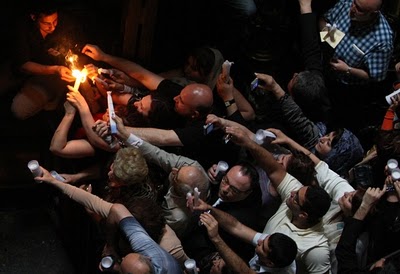
We Are An Easter People

“I came into the world as light, so that everyone who believes in me might not remain in darkness.  And if anyone hears my words and does not observe them, I do not condemn him, for I did not come to condemn the world, but to save the world.”  John 12:46-47

Another Easter Vigil has come and gone.  In our parish, there are 22 new Catholics, and in our Archdiocese, the largest number of converts in its history.  Why do you think this is happening?

I think the answer can be found in the passage above.  It seems as though we are living in a dark time.  There is hopelessness, anger, worry, a lack of trust.  Gratefully, there are many people are turning to God for the “Light” which will banish their darkness.

On Confirmation retreats, I like to use the image of Jesus probing our hearts with a flashlight, shining His Light on the places we’d rather keep hidden.  That is the only way true healing can occur, but we have to let Him in.  That’s what is happened to all these folks who have made the decision to become Catholic.  Let our prayer be that they, along with us, always remain in the Light of the Risen Christ.

Pope John Paul II, in his first homily as Pope, summed things up by saying, “We are an Easter People, and Alleluia is our song.”  We are not “Good Friday People,” although there would have been no Easter without the passion and death of Jesus.  But the story continued, a new chapter began.  And so it is with us.  We turn from dark to Light, and nothing is the same.

Let’s pray that the Light burn brightly, banishing our personal and communal darkness.  Alleluia

Categories
Papacy Spirit

John Paul II

Five years ago today, Pope John Paul II returned home to his Father’s house.  When he died, it was like everyone lost a dear friend, a confidant, a teacher.  As we remember him on this Good Friday, here are a few lines from a meditation he wrote, found in his book of poetry entitled “Roman Triptych.”

Fulfillment-Apocalypsis

The End is as invisible as the Beginning.

The universe came forth from the Word,

and returns to the Word.

In the very center of the Sistine Chapel, the artist

depicts this invisible End

in the visible drama of the Judgement-

This invisible End has become visible as

the height of transparency:

Omnia nuda et aperta ante oculos Eius!

(All is laid bare and revealed before his eyes)

Matthew’s words are here transfigured in the painter’s vision:

“Come, you blessed… depart from me, you accursed…”

And so the generations pass-

naked they come into the world and naked they return

to the earth from which they were formed.

“From dust you came, and to dust you shall return”;

What had shape is now shapeless.

What was alive is now dead.

What was beautiful is now the ugliness of decay.

And yet I do not all together die,

what is indestructible in me remains!

Categories
Catholic Church Papacy Spirit

Holy Thursday

This image of Christ washing the feet of His Disciples is from a series of frescos painted by Giotto and found in the Scrovegni Chapel in Padua.  I have been blessed to have seen the originals more than once, and they are precious and powerful, and the story about how they survived World War Two is miraculous.  They are, however, not the main story today.

Tonight, the Church commemorates the Institution of the Priesthood and of the Eucharist.  As I was praying this morning, it was hard not to be drawn into the turmoil surrounding both at this time in our history.  Without a doubt, these are difficult days, but hope is not lost, the story will not end this way.  Something comes after Good Friday!

Without going into a lengthy discourse, I think the answer to the present problems lies in the words of Christ spoken right after He washed the feet of His disciples (John 13:15).  Jesus says “I have given you a model to follow, so that as I have done for you, you should also do.”

Could the answer to so many of our present problems be connected to the way we have lived out this model Christ gave to us?  I think so.  We would not find ourselves in such a mess, whether it be our country,  our Church, or even our personal lives, if each and every one of us were living lives that faithfully mirror the life of Jesus.

The Lord knew at the Last Supper that the story would not end there.  It couldn’t.  More had to be done, because He knew we would not live up to the model He laid out that night.  We’ll save that part of the story for tomorrow and Saturday.

Last April, I attended a daily Mass at my parish.  In our pastor’s homily that morning, he said something that I wrote down as soon as I got home.  He said, “whenever something is crazy in your life, go to the Eucharist.”  I was struck by the simplicity of the message, and I think it has important relevance today.

It seems to me that there is much to be angry about right now in our world. However, instead of turning up the volume, the hostility, the downright hatred, we should turn to the Eucharist for our answers.  Make a Holy Hour for our country, our President, our elected officials.  Make a Holy Hour for those who have been abused.  Make a Holy Hour for those who did the abusing.  Make a Holy Hour for those who have harmed us in any way, and for those we have harmed.

Christ told us He is the Way, the Truth, the Life.  He has the answers and the means to solve all our problems.  It is Love.

We celebrate these Holy Days because of His great Love.  This is the model He left us.  It is the solution to all our problems,  past, present and future.

May God bless all our priests, and may they faithfully follow the Way of the Master, our Great High Priest.

“When something is crazy in your life, go to the Eucharist.”  Amen

Categories
Catholic Church Papacy Spirit

Make it a Holy Week

And so it begins again. Holy Week is here, starting today with Palm Sunday.  Yesterday, we had our annual RCIA retreat for all those coming into the Church at the Easter Vigil.

How blessed we are to be able to journey alongside these people seeking God.  I wish sometimes that our group was smaller, that I could get to know each person more deeply, but the Lord keeps bringing large groups of people seeking to be Catholic to our doors.

As we sat together yesterday, it was so great to hear some of their conversion stories, how God has touched them profoundly through the RCIA process, and how they intend to live out this new faith of theirs.

This Holy Week, I hope that we can all take time, personally and communally, to reflect on the mysteries the Church rolls out for us. Where do we fit into the story?

Do we follow Christ’s example from the Holy Thursday Liturgy, or are we more often like someone from the angry crowd shouting “crucify him?”  To me, one of the chief joys of our faith is that conversion doesn’t happen just once.  Conversion is ongoing, and every day is a chance to re-commit, go deeper, and seek his mercy and love.

Let’s pray that this Holy Week is a time of reflection, quiet, and conversion.

This morning, I was let to pray the Suscipe, written by St. Ignatius of Loyola.

Take, Lord and receive all my liberty,

my memory my understanding, my entire will-

all that I have and call my own.

You have given it all to me.

To you, Lord, I return it.

Everything is yours; do with it what you will.

Give me only your love and grace.

That is enough for me.