Categories
Catholic Church Italy Papacy Travel

Corpus Christi

In the Catholic Church, today is the Feast of Corpus Christi, a day we commemorate Christ’s desire to remain with us always in the Eucharist.

This special feast began centuries ago in the Umbrian town of Orvieto.  The story is somewhat lengthly, and I think I’ll save it for another time.  Today, I wanted to write about the town of Orvieto and it’s great Cathedral, two of my favorite places to visit in all of  Italy.

Several years ago, I was leading a tour of Italy, and many close friends were on the trip.  We visited the usual tourist sites, and after leaving Assisi and heading south to Rome,  I built into the itnerary a visit to Orvieto.  As we were leaving, someone came up to me and said something like, “My whole life I’ve heard about Florence, Pisa, Assisi and Rome.  I can’t believe no one ever told me about Orvieto.”  Once you go there, you’re hooked!

Orvieto is situated on the flat summit of a large butte of volcanic tuffa.  The site of the city is one of the most dramatic in Europe, rising above the almost vertical faces of the tuffa cliffs.  Since there is very little car traffic allowed in the city center, buses have to stay down in the valley below.  To reach the city, you have to travel on a funincula, a kind of tram that hugs the mountain as it goes up to the top.

You may recall the song Funincula Funinculi.  The story goes that, at one time, these kinds of trams were operated by people pulling ropes that lifted the tram either up or down.  I always get it mixed up, but I think  funincula meant going up, and funinculi meant heading down. I can’t imagine the strength that was necessary to get these people movers up and down.

Back to the Cathedral.  To me, it’s facade is one of the most beautiful in the world.  Done primarily in mosaic, the artist used a lot of glass pieces that must have been gold -leafed on the back, because when the sun hits the cathedral, it’s like a thousand lightbulbs going off.  Remarkable.

The cornerstone was laid by Pope Nicholas IV in 1290, and the magnificent church was completed in the mid fifteenth century.  The walls are striped in white travertine  and greenish-black basalt, in narrow bands.  This was the first church I had ever seen this style, and it is striking.      This great cathedral was built to commemorate the Eucharistic miracle of Bolsena.  The pope at the time, who verified the miracle himself, later asked St. Thomas Aquinas to write songs to commemorate the event, and he produced two pieces that are still sung on a regular basis in Catholic Churches all over the world, O Salutaris, and Tantum Ergo.

There are two main things to see in the cathedral.  One is the chapel of the miracle, and the other is the Brizi Chapel, which houses one of the great frescoes of the Renaiassance, the masterpiece by Lucca Signorelli known as the Last Judgement. I think this fresco is one of the greatest works of art I have ever seen, and I could sit for hours in this small chapel and take in the artistic drama and mastery captured there.  It is no wonder that historians say that this is where Michaelangelo came for inspiration before painting the Sistine Chapel.

Any photograph can’t really caputure the powerful imagery on these four walls of the chapel.  One day, I hope you’ll have the chance to see it for yourself in Orvieto.  In the meantime, there are Signorelli paintings in museums all over the world, including one right here in Baltimore.  If you can find one, I don’t think you’ll  be disappointed.
Categories
Catholic Church Italy Travel

Tuscany Pt. II

At church on Sunday, a young man I’ve known for many years came up to talk with me.  Seth had just returned from a semester in Florence.  We had talked excitedly before his trip. I love to tell people about some of the more obscure places to visit when they’re in Tuscany. Florence is filled with them.

Seth lived and took his classes in the center of Florence near Santa Croce. Built in 1294, this great Gothic church is where you’ll find the tombs of Michelangelo  and Galileo.   The piazza in front is where you can buy inexpensive watercolors, leathergoods, and way too much touristy junk.

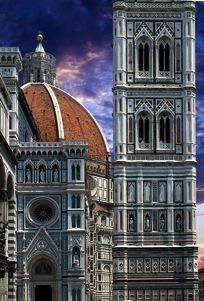
An area of Florence I like to hang out in is called, Oltrarno, which means “over the Arno.”  At one time, you were considered inferior if you lived on this side of the Arno, because it meant that you couldn’t afford to live in a big palazzo in the city center.

All that changed when the Medici family decided to jump over and build a massive palace in 1550.  They ruled Florence from the Palazzo Pitti for the next 300 years.

When I’m in Florence, Oltrarno is one of the first places I venture to.  After crossing the Arno by way of the Ponte Vecchio, where gold merchants have been selling their wares for centuries, you make a right and follow a small street which runs parallel to the river.  My family and I love to visit a little art gallery on this street. Years ago, when the dollar was very strong against the Lira, we bought some paintings there.  Now, I can’t imagine paying the prices that hang on the tickets.

So, instead of buying paintings, I walk down a few buildings and enter a little tiny shop where all the lady sells is gift wrap.  Now, this isn’t your usual kind of wrapping paper.  This stuff is hand printed and sold by the sheet.  Mainly geometric designs, the paper is inexpensive and beautiful.  I usually buy about twenty sheets,which can be folded easily and tucked into the suitcase.  On very special occasions, my friends get their present wrapped in one of these special papers.

This side of the Arno is filled with craftspeople making all kinds of beautiful objects.  Restoration studios abound as well, with artisans working on priceless objects from museums.

Obviously, I could go on and on.  I love Florence, and if I were rich, I’d have an apartment here.  It is simply an amazing city that I don’t believe you could ever get bored with.

I asked Seth if he had tried Cinghiale (wild boar). Yes, he had, and loved it.  Good man, Seth.  Unfortunately for him, it was on one of his last days.  Wild Boar has to be marinated and cooked for a long time.  It is one of my favorite Tuscan foods, and I promise you now that I will view eating numerous servings on my next visit as a way to remind myself just how much I gave up when I became a vegetarian 🙂

To finish up, sometimes we tourists can get overwhelmed in a place like Florence.  At first, it’s almost like we’re on some movie studio lot, or at Disney World and we’re seeing imitations of the real thing.  Lots of history was made in Florence, some great, some not so great.

During World War II, bitter fighting took place in the piazzas we sample our gelato.  Partisans were hung from the lamp posts to warn others about the consequences of joining the fight.  The fighting here was bad and street to street.

I learned a lot about all this in a book  entitled War In Val D’Orcia,written by Iris Origo and recommended by Frances Mayes.  I think reading this book helped me to be a better kind of  tourist, one who takes less for granted, realizing how precious is the gift of these experiences.

Somehow, I’m  thinking there are going to be many parts of my Tuscan tale to come….

Categories
Catholic Church Ignatian Spirituality Italy Mind Spirit Travel

St. Catherine of Siena

Today is the feast day of St. Catherine of Siena (1347-80), a one of only three  women who have the title Doctor of the Church.  Over the summer, I picked up a biography of this great saint entitled The Road To Siena written by Edmund Gardener.  I’ll leave it to you to find out more about Catherine.  I just wanted to bring her up because, as I learned through reading this biography, she was one tough person who rose above the difficulties of her time and became a shining example of holiness.

Sometimes, actually, I think most of the time, every generation thinks that they have it worse than another other age.  We wonder how we will ever survive, yet alone thrive through whatever comes our way.  Reading the story of St. Catherine reminded me that we have been through worse times.  Catherine lived in a time of plague, heresies, schisms, object poverty and absolute decadence.  Sinful behavior seemed to reign.  In the end, though, people like St. Catherine kept it together, calling people to task, challenging those in power at the time to live for holiness.  Her forceful voice remains with us today, and her words speak to our time.  Maybe Pope Paul VI had this in mind when, in 1970, he declared her the first woman Doctor of the Church.   Read up on her.  Ask for her intercession, for ourselves, and for our Church.

Categories
Italy Travel

Ah, Tuscany Pt. I

Frances Mayes is out with a new book entitled Every Day in Tuscany. Mayes is the author of several books about life in Italy, and she is one of my favorite authors.  I’m about half way through this latest memoir, and so far, it hasn’t disappointed.

Her writing style is such that she draws you into the story, the experiences, and its as if you get to meet the people, share the food, drink the wine, see the sights right along with her.  I love it.

I was talking to my mom last night about the book, and she hadn’t heard it was out yet, but I think she’ll head out today and get her copy.  Several years ago, my family took at trip to Italy, and stayed in Cortona for a few days.  It is a beautiful little hilltown, and we wanted to see for ourselves what drew Mayes and her husband Ed to settle in this place that seems to date from forever.  We weren’t disappointed as we ate in the little tratorria she loves, bought perfectly ripe peaches from the frutta e verdura shop the size of a postage stamp that she buys her produce from.  We visited the museum where Fra Angelico’s magnificent  painting of the Annunciation hangs, bought plates and cups in the traditional pattern of Cortona.  At Christmas, I bring out my copy of the Annunciation and hang it on the wall in my living room.  When I’m depressed about something, or want to celebrate a special occasion, I eat off those plates.  For a moment, I’m back in Cortona, enjoying the sweet life…

Mayes draws you in to her experiences, and she leaves her readers longing for a little taste of la dolce vita.  As we were leaving Cortona, my mom asked the cab driver if he knew were Bramasole, the abandoned house Mayes and her husband had restored.  “Si, si,” he replied, and off we went into the hills.  Bramasole, which means to “yearn for the sun” in Italian, is not the grandest house, but I would take it in a heartbeat.  My mom noticed the windows were open.  “Are they home” she wondered?  We stood outside their gates, laughing, taking pictures, dreaming about what it would be like to live in this place.  I love the picture we have of my mom, with a big smile, standing at the gates of Bramasole.

In this latest book, Mayes writes that, even though the people at the gate don’t realize it, she and her husband do hear the laughing, the conversations, good and bad.  As I read this, I kicked myself that we didn’t yell up that day.  My mom would have loved to have been invited in to look around.  She may have decided to stay another day…

In my mind, there are few places in the world that get me dreaming as does Tuscany.  I’ve lead several tour groups there over the years, and after the last one, with the weak dollar and sky-high prices, I said that was it, no more tours!

That lasted about two years, and as I write this, I’m beginning to plan a fifteen day trip all over Italy for the summer of 2011.  I’m ready.